
Lee County Weekly Arrest Log
Lee County runs no Sheriff booking blotter. The best official feed comes from the Fort Madison Police Activity Log. Its landing page stacks weekly and monthly posts. It is not a rolling county jail roster. A typical entry lists a date, a time, an adult name, and the alleged offense. Locations, warrants, and outcomes appear too, from citation to release to transport to Lee County Jail. The log-to-jail distinction matters. A Fort Madison citation may skip jail entirely. A Sheriff or Keokuk arrest may never show up there, since a different agency holds that record. West Point keeps city arrest records under its code but publishes no web blotter. No single log lists every arrest in Lee County.
Read Fort Madison Arrest Posts
Start with the department's own posts, then verify the details you care about. The log tells the story of the event. Booking papers and court outcomes live elsewhere.
- Open the Fort Madison Police Activity Log and choose a weekly or monthly post covering the likely incident date.
- Match the date, time, location, and name carefully. Similar names and corrected spellings can cause a false match.
- Read the outcome words. “Cited and released” differs from “transported to Lee County Jail” or “held.”
- For present custody, call the Lee County Jail at 319-376-2355 or check IowaVINE through the official state route.
- For an official copy, contact FMPD for its incident record and the Sheriff for a county booking packet.
For a possible arrest today, try the Daily Arrest Report instead. That page leads with jail contact and VINE. Fort Madison's log may not list the event yet. The county-wide recent-arrests hub covers city, jail, court, and state records. It shows how they connect. The official Fort Madison blog displays its running activity posts.
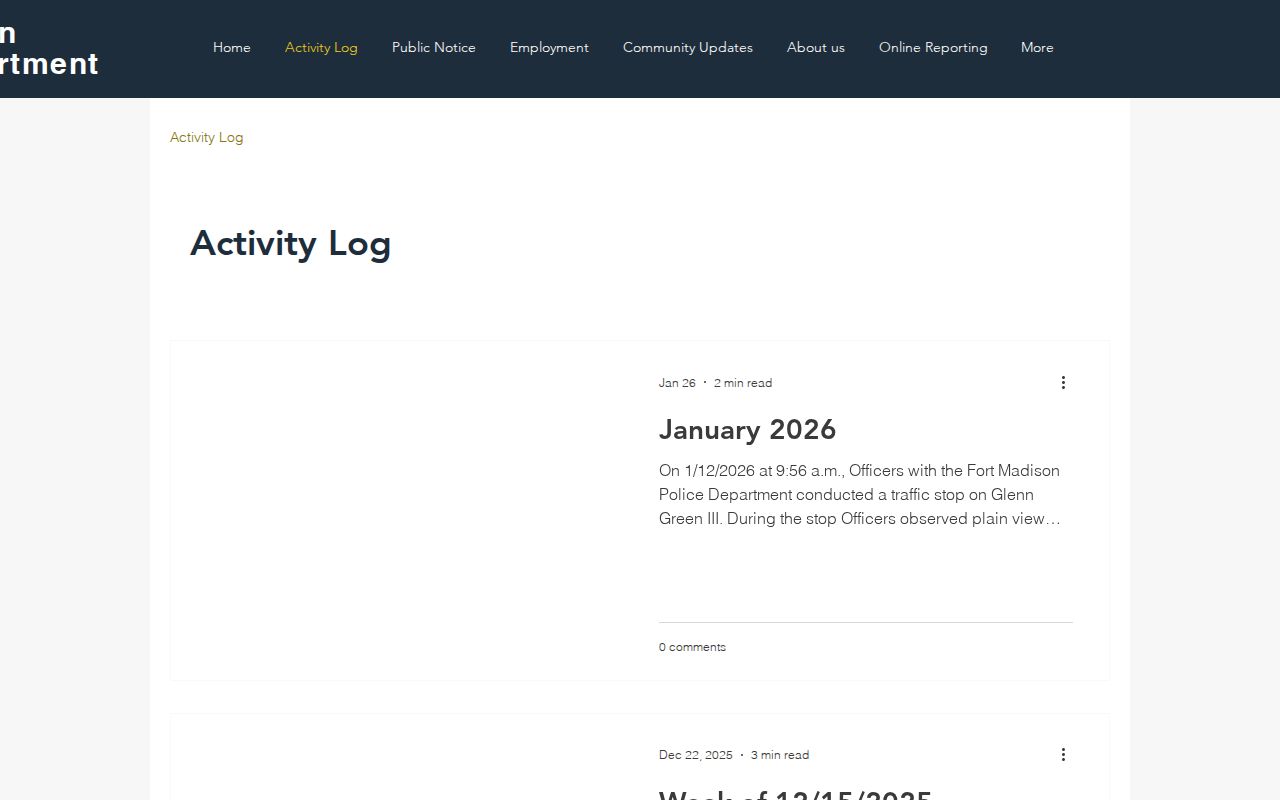
The screen is an agency publication index, not a gallery of booking photos.
Lee County Arrest Entry Fields
Fort Madison entries follow a consistent field set. Expect blotter-style elements, not a full Lee County Jail booking packet.
| Log element | How to interpret it |
|---|---|
| Incident date and time | When police recorded the event, which may differ from jail intake. |
| Adult name | The identity published in that entry; restricted records may omit a name. |
| Charge wording | The alleged offense at the police stage, not the final court result. |
| Location | An address or intersection when included and releasable. |
| Outcome | Arrested, cited, released, held, or transported, depending on the entry. |
| Warrant context | A reference in the report, not a complete active-warrant verification system. |
| Photo | No routine booking-photo field was established in the sampled activity text. |
A blotter entry freezes one moment in time. For the docket, check Iowa Courts Online once it posts. Identity questions need more than a matching name. Ask for the incident number and the arresting agency instead.
Weekend Lee County Arrest Reports
Weekends and holidays slow everything down. Each step runs on its own clock. Fort Madison posts on no fixed day. A weekly title in the log describes the covered span, not a guaranteed publication deadline. Check adjacent posts for incidents near midnight. A post that appears days later does not mean the arrest happened days later. A missing post does not mean nothing happened. For a specific incident, call the right agency. The jail answers current-custody questions, while a police records contact handles the city report. Court dockets trail behind, and Iowa guidance notes that citations can take 10 to 14 days to appear, longer over weekends or holidays. Patience and a phone call usually settle what a log leaves open. One weekly activity post shows the format for a single week.
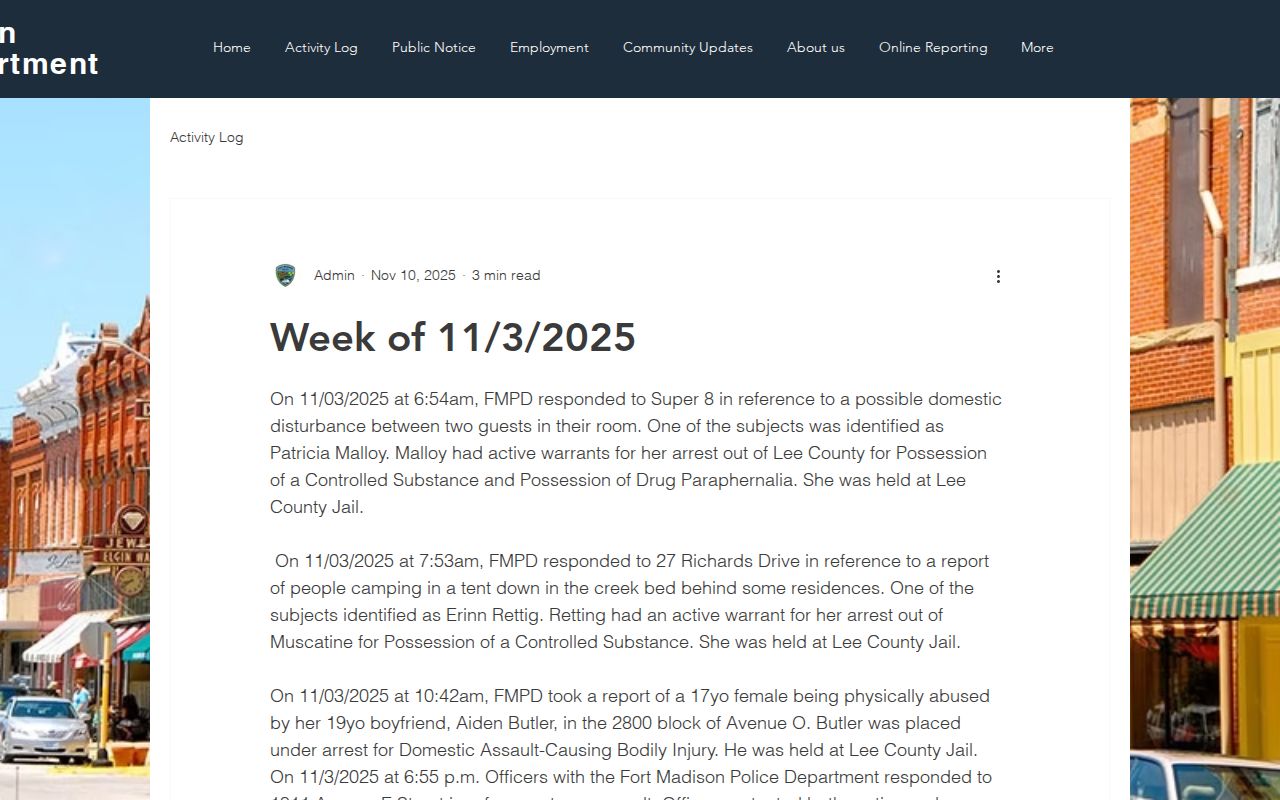
It is a police account, not a jail roster.
Lee County Log Archives
Older Fort Madison posts stay on the site, though no fixed retention period is posted. Lee County likewise publishes no schedule for how long booking cards, photos, release entries, or online items remain available. A vanished post does not prove destruction. A third-party copy proves nothing about the custodian either.
Gather the person, the date range, the agency, and any incident or booking number, then ask where the file lives. It may have stayed, moved, or been destroyed. Lee County's records-request page links the form and fee terms. A Fort Madison police file and a Sheriff jail packet can follow separate rules.
Sometimes an office reports no responsive file. Ask which agency created the record. Also ask whether a retention schedule controls the answer. Public-records law does not force staff to build a log that never existed. Save the date, URL, and title of each post. Page order and access can shift even while the agency file follows its own schedule.
Prison history is not county arrest history. Iowa State Archives holds penitentiary registers and parole material. Those are prison records, not a local log. Newspapers like the Daily Democrat and Pen City Current may keep contemporaneous reports. They are publications, not records. Check them for context only.
City Arrest Coverage Is Uneven
Arrest coverage across Lee County runs at three different speeds. Fort Madison posts the strongest official blotter, maintained by its own police department. Keokuk has no KPD arrest log online. Coverage there depends on Keokuk Police records plus confirmation from the jail. West Point is different again. Its city police handle arrest-record requests. Chapter 30 of the municipal code writes that duty into law. That patchwork explains the confusion. The FMPD log can never be described as a Lee County Sheriff blotter. Local newsrooms fill some gaps, but none completes the roster. The Daily Democrat prints Lee County Sheriff items. Daily Gate City follows Keokuk and the south county, and Pen City Current carries Fort Madison's "For the Record" material. KBUR, KWQC, and WGEM jump on bigger events. One caution applies here. An illustration beside a story is not always a booking photo. No outlet offers a complete county-wide mugshot feed for recent arrests.
Arrest Statistics Are Not Names
Iowa's state numbers count arrests, not people. The official Iowa DPS Arrest Distribution tool filters those totals by date, agency, municipality, offense, and reporting dimensions. It suits careful trend research. It names no one booked into Lee County Jail. Never infer a person's arrest from it. Raw weekly totals can mislead, too. A busy stretch of the log may reflect publication timing, agency coverage, or a few unrelated events rather than a true surge. A defensible count needs a date range, a reporting agency, and a source. The filter controls sit on the Iowa DPS report page for anyone who wants the breakdown:
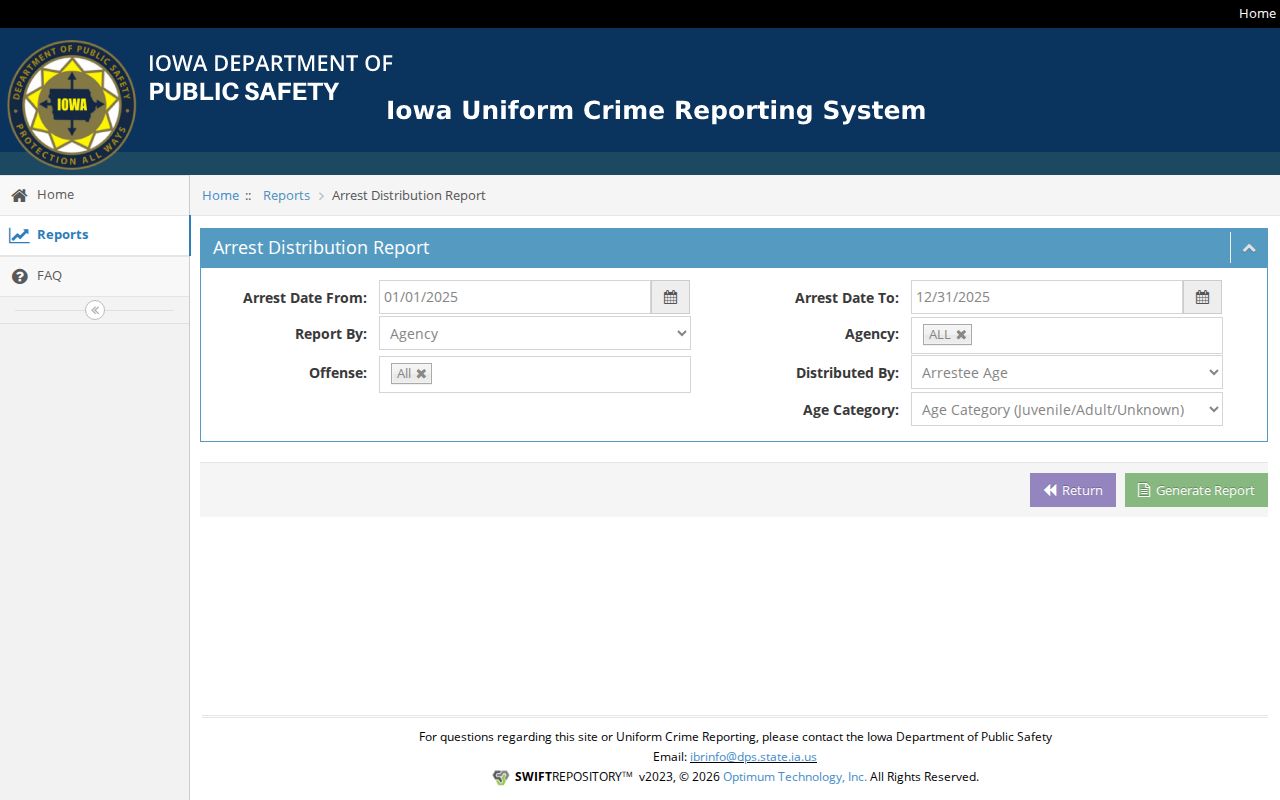
It shows totals, never a named Lee County roster.
Lee County Publication Changes
Has Lee County pulled an arrest log? Nothing supports that story. The county publishes no Sheriff booking feed. It posts no booking-photo policy either, so there was nothing to remove in the first place. What its public pages offer instead: jail contacts, public-records procedures, VINE, and court links. That pattern is real, but it is not proof of a recent change. Two developments are worth watching. One is a proposed Iowa bill limiting booking photos. The other is the county's passing mention of a county app. Neither supports a claim that arrest-log rules changed; the app has no confirmed booking module, and the bill has not been enacted, so check the official county site before changing your lookup route.